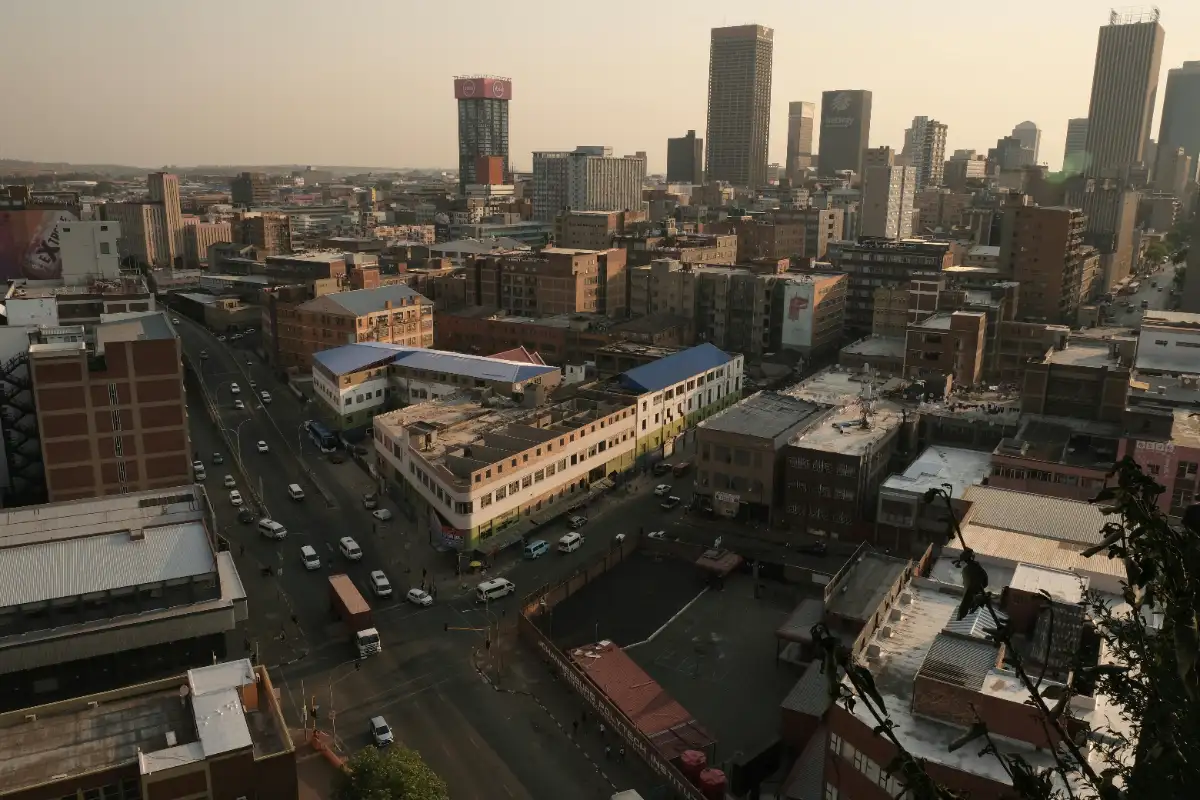
Johannesburg arrives before it introduces itself. You are still in the air, descending through a sky that sits higher than almost any other major city on earth at seventeen hundred and fifty metres above sea level, and already you can see it below you: the largest urban forest on the planet, ten million trees planted over a century by a mining settlement that grew too fast to be beautiful and ended up being magnificent instead. The jacaranda canopy is purple in October. The mine dumps on the southern edge of the city glow gold in the afternoon light like something from a mythology that is still being written.
Unique things to do in Johannesburg are not buried deep or hard to find. They are everywhere, pressing against the surface of a city that has never resolved its contradictions and has instead learned to live inside them with a particular kind of energy that no other African city quite replicates. This is not Cape Town's scenic beauty or Nairobi's safari proximity or Zanzibar's island languor. Johannesburg is something rawer, more urgent, more honest about what it cost to build and what it is still in the process of becoming.
For the ordinary traveller who is willing to stop treating Johannesburg as a transit hub or a reluctant stopover and start engaging with it as the genuinely extraordinary city it is, this guide navigates the iconic, the hidden, the historically essential, and the surprisingly joyful experiences that this city holds in reserve for anyone paying attention.
The Experiences in Johannesburg That Are Famous for Exactly the Right Reasons
The Apartheid Museum — History as Architecture
There is no adequate way to prepare yourself for the Apartheid Museum. You can read the historical summary, study the photographs in advance, remind yourself that you are about to spend two hours in one of the most important human rights museums in the world. None of it is sufficient preparation for the experience of walking through the entrance and being separated by race at the gate, directed through either the whites only or non whites only turnstile by a ticket that randomises your racial classification, and then spending the next two hours inside a building that uses space, light, sound, and the accumulated weight of documented suffering to make history something you walk through rather than read about.
The Apartheid Museum opened in 2001 on the southern edge of Johannesburg, adjacent to Gold Reef City, and was built as a condition of the casino licence granted to the site. The building itself is a design achievement of the first order. Architects Gapp, MRA, and RGB used raw concrete, rusted steel, barbed wire, and glass to create a structure whose material language carries the emotional register of the subject it houses before you have read a single panel of text inside.
How to Make the Most of Your Apartheid Museum Visit
Allow a minimum of three hours. Many visitors underestimate the depth of the collection and the emotional pacing required to move through it without shutting down. Go on a weekday morning when the museum is least crowded and the audio guide commentary is audible without competition. The museum contains material of significant emotional intensity, including photographs, film footage, and personal testimonies from both victims and perpetrators of apartheid era violence. It is appropriate for older teenagers and adults. Parents of younger children should review the content advisory at the entrance before proceeding.
Soweto — The Township That Changed the World and Has Not Finished Doing So
Soweto, the South Western Townships southwest of the Johannesburg CBD, is the most politically significant urban settlement in modern African history. It was here, in June 1976, that schoolchildren marched against the government's imposition of Afrikaans as the language of instruction and were met with live ammunition. The Soweto Uprising and the global outrage it generated accelerated the international isolation of the apartheid government and changed the trajectory of the liberation struggle. The streets where that happened are still here, still named, still lived on by people whose parents and grandparents were part of the story.
But Soweto in 2026 is not a museum to its own past. It is a living city of over a million people that contains Vilakazi Street, the only street in the world to have housed two Nobel Peace Prize winners, Nelson Mandela and Archbishop Desmond Tutu, as well as the most visited soccer stadium in Africa, a thriving craft brewery scene, one of the best traditional Zulu food restaurants in South Africa, and a township cycling tour culture that has produced riders who now compete internationally.
How to Visit Soweto Ethically and Meaningfully
The difference between an extractive township tour, which drives visitors through poor areas as though poverty is a spectacle, and a genuinely meaningful Soweto experience is entirely a function of who guides you and how the experience is structured. The best Soweto guides are residents who grew up in the township, who have specific personal connections to the history of specific streets, who eat at the local shisa nyama braais they take you to rather than performing enthusiasm for an audience, and who introduce you to people by name rather than pointing at them from a vehicle. Book through a platform that applies this standard. The experience that results is not comfortable and polished. It is real, which is worth considerably more.
The Johannesburg That Most Ordinary Travellers Walk Right Past
Constitution Hill — Where Injustice and Justice Share a Postcode
Constitution Hill in the Hillbrow neighbourhood of Johannesburg is one of those sites that should be on every visitor itinerary and is somehow present on almost none. It is the location of the Old Fort Prison complex, built in 1893 and used for over a century to detain and process political prisoners, common law offenders, and anyone the state of the day chose to incarcerate, which at various points in South African history included Mahatma Gandhi, Nelson Mandela, and tens of thousands of black South Africans detained under pass law legislation.
Today the Old Fort complex houses the Constitutional Court of South Africa, the apex court that interprets and upholds the post apartheid constitution ratified in 1996. The court building was deliberately constructed around and through the ruins of the prison, using bricks reclaimed from demolished prison cells in its walls, incorporating the original prison buildings as atriums and galleries, and placing the courtroom, where the country's most significant legal decisions are made, directly adjacent to the cells where its judges' predecessors were once held without trial.
The result is a building that functions simultaneously as a working court, a public art gallery, a museum, and a piece of architectural argument about the relationship between past injustice and present justice. On days when the court is not in session it is open to the public and free to enter. It is the most architecturally and philosophically coherent building in Johannesburg and almost nobody knows it exists.
The Number Four Women's Jail
Within the Constitution Hill complex, the Number Four Women's Jail holds a particularly specific and affecting history. Winnie Madikizela Mandela was detained here. So were many of the women who formed the backbone of the anti apartheid movement while the men in their lives were imprisoned on Robben Island. The cells have been preserved and the guided tour of this section of the complex, offered by guides who are trained in the oral histories of specific former inmates, is among the most powerful single hours available to a visitor anywhere in Johannesburg.
Maboneng Precinct — The Creative Neighbourhood That Rewired the City's Imagination
A decade ago, the streets east of the Johannesburg CBD around Commissioner and Fox were derelict warehouses, abandoned factories, and the kind of urban infrastructure that cities tend to forget about. Then a young property developer named Jonathan Liebmann began converting the buildings into studios, apartments, galleries, restaurants, and performance spaces under the brand Maboneng, a Sotho word meaning place of light.
What happened next is both a story of genuine urban creative revival and a complex conversation about gentrification, displacement, and who a city is being revived for. Both are true simultaneously and both are worth engaging with rather than resolving neatly. What is unambiguous is that Maboneng today is the most visually interesting and creatively dense neighbourhood in Johannesburg, home to some of the best coffee, the most adventurous contemporary African art, and the most unusual Sunday market on the continent in the form of the Arts on Main monthly market.
The street art in and around Maboneng is a gallery without walls, changing faster than any museum collection and operating entirely outside any curatorial gatekeeping. Walking it with a local guide who knows the artists and can tell you which piece appeared overnight and why is one of the most genuinely surprising hours available in the city.
A Johannesburg Food Tour — The Braai, the Bunny Chow, and the New African Kitchen
Johannesburg's food culture is one of the most underrated in Africa. It is a city of eleven official languages and it eats accordingly, drawing on Zulu, Sotho, Xhosa, Cape Malay, Indian, Portuguese, and a range of other culinary traditions that have been colliding and cross pollinating in Joburg kitchens for over a century. The result is not a unified cuisine in the way that Thai food or Italian food is unified. It is a living argument about identity conducted through ingredients.
The shisa nyama braai culture of Soweto, where meat is selected, weighed, seasoned, and grilled to order at an open fire while a sound system negotiates the atmosphere, is one of the most pleasurable eating experiences in South Africa. The bunny chow, a hollowed out quarter loaf of white bread filled with curry that originated in the Indian community of Durban and has migrated with extraordinary thoroughness into Johannesburg's street food landscape, is one of the most satisfying single dishes on the continent. The new wave of restaurants in Maboneng and Newtown that are reframing traditional African ingredients within contemporary culinary frameworks are producing food that is earning international attention and deserves local engagement first.
A guided food tour of Johannesburg is the most calorie efficient way to understand the city's social history, and the best ones move between Soweto, the CBD, and the creative neighbourhoods in a single day.
What Every Ordinary Traveller Needs to Know Before Visiting Johannesburg
Safety in Johannesburg — The Honest Conversation
Johannesburg has a safety reputation that is both earned in specific contexts and wildly exaggerated in others. The city is large, economically unequal, and contains areas where petty crime, vehicle crime, and street crime are genuine everyday realities. It also contains vast neighbourhoods, shopping districts, restaurant areas, and cultural sites where millions of people live, work, and move freely every single day without incident.
The rules for a visitor are not dramatically different from those that apply in any large city with significant economic inequality. Do not walk while looking at your phone on unfamiliar streets. Do not leave valuables visible in a parked vehicle. Use a reputable ride share application rather than hailing taxis on the street. Travel with a local guide for township visits and unfamiliar neighbourhoods. Book experiences through operators who provide clear safety guidance and have established relationships inside the areas they work in.
Johannesburg is not the city its worst reputation describes. It is also not without genuine risk in specific contexts. The ordinary traveller who respects both of those facts simultaneously will have a far better experience than the one who either dismisses all concerns or allows excessive anxiety to prevent them from engaging with one of the most remarkable cities on the African continent.
Getting Around Johannesburg
Johannesburg's public transport infrastructure is improving significantly. The Gautrain rapid rail system connects OR Tambo International Airport to the Sandton CBD in approximately fifteen minutes and extends to Rosebank, Park Station, and Pretoria. This is fast, safe, air conditioned, and the most reliable transport option for airport arrivals and departures. Within the city, the Rea Vaya bus rapid transit system covers significant portions of the CBD and Soweto corridors. For most visitors, however, the practical reality of getting around Johannesburg is a combination of the Gautrain for airport and Sandton connections and ride share applications for everything else.
The Best Neighbourhoods to Stay In
Sandton is the obvious and most infrastructure rich choice for first time visitors, with excellent hotels, a major mall complex, and the Gautrain connection. Rosebank offers a slightly more relaxed atmosphere with good restaurant access and walkable streets within its immediate precinct. Maboneng has a small selection of boutique accommodation options that place you directly inside the creative heartbeat of the city. Avoid staying in the CBD unless you have specific local knowledge and experience; the central business district is undergoing significant urban renewal but remains uneven in its safety profile.
The Best Time to Visit Johannesburg
Johannesburg sits on the Highveld and has a climate that surprises most visitors with its pleasantness. Winters from June through August are dry, sunny, and cool with daytime temperatures typically between fourteen and twenty degrees Celsius and cold nights that can drop below zero. The air is clear and the jacaranda trees are bare but the light is extraordinary. Summers from November through February are warm and humid with dramatic afternoon thunderstorms that arrive punctually at around three in the afternoon and clear within an hour, leaving the air cool and clean. The jacaranda blooms occur from late September through November and turn the northern suburbs into one of the most visually spectacular urban environments in Africa.
Book Your Johannesburg Experience Through Plan My Experiences
Why the Right Local Guide Makes Johannesburg a Completely Different City
Johannesburg is a city that reveals itself in layers and the depth of the layer you access is almost entirely determined by who shows you around. The Apartheid Museum is profound visited alone and transformative with a guide whose grandmother was a domestic worker in Johannesburg during the years the museum documents. Soweto is interesting seen through a vehicle window and genuinely life altering walked slowly through with someone who grew up on Vilakazi Street and knows which house belonged to which family.
Plan My Experiences connects ordinary travellers with the most knowledgeable, community embedded, and personally invested local guides and operators working in Johannesburg today. These are not generic city tour providers. They are people with specific expertise in specific neighbourhoods, specific historical periods, specific food cultures, and specific creative scenes who offer experiences that are impossible to replicate through any other booking mechanism.
How to Find and Book Johannesburg Experiences Through Plan My Experiences
Visit the Plan My Experiences website and search for Johannesburg. The platform surfaces a curated selection of experiences across the city's most compelling categories: township cultural tours, Apartheid Museum guided visits, Constitution Hill historical walks, Maboneng street art tours, Soweto food experiences, and personalised city itineraries built around your specific interests and available time.
Every listing includes full operator details, transparent pricing with no hidden fees, verified reviews from previous travellers, and direct communication tools. You read what the experience actually involves, you hear from people who have done it, and you book directly with the local specialist delivering it. There is no intermediary taking a margin in exchange for adding nothing. The platform's commission is charged only on confirmed bookings, which means every operator listed there has a direct financial incentive to deliver an experience worth returning for.
For Local Operators and Experience Providers in Johannesburg
If you lead township tours, historical walks, food experiences, art tours, cycling routes, or any other visitor experience in Johannesburg, Plan My Experiences gives you direct access to an international and domestic audience of ordinary travellers who are actively choosing to engage with the city beyond its surface.
Listing your experience is completely free. You set your own pricing, manage your own availability, and present your offering in your own words. Plan My Experiences takes a fair commission only when a booking is confirmed. This means the platform grows only when the experiences it lists are good enough to generate bookings and reviews worth repeating. Revenue stays in Johannesburg, in the communities that hold its stories, and with the guides who know how to tell them.
Johannesburg Does Not Forgive Half Attention But It Rewards Full Engagement Completely
Unique things to do in Johannesburg are not exotic or extreme or available only to those with specialist knowledge. They are available to any ordinary traveller who is willing to show up with genuine curiosity and the humility to be taught something by a city that has been through more in the last century than most places experience in a millennium.
Walk through the Apartheid Museum without rushing. Eat at a shisa nyama in Soweto with someone who grew up there. Stand in the Constitutional Court and read the values inscribed in its walls. Buy something from the Arts on Main market from the person who made it. Drink a coffee in Maboneng and look at the street art on the wall across the road and ask your guide who painted it and why, because the answer will be worth the asking.
Johannesburg is not a comfortable city. It is a consequential one. And the ordinary traveller who engages with it on those terms comes home having seen something that does not fade quickly, a city still in the process of becoming what it decided to be, and generous with the view to anyone paying close enough attention.
Start your Johannesburg journey through Plan My Experiences. Find your local guide, book your experience, and arrive ready to be surprised by one of Africa's most extraordinary cities.