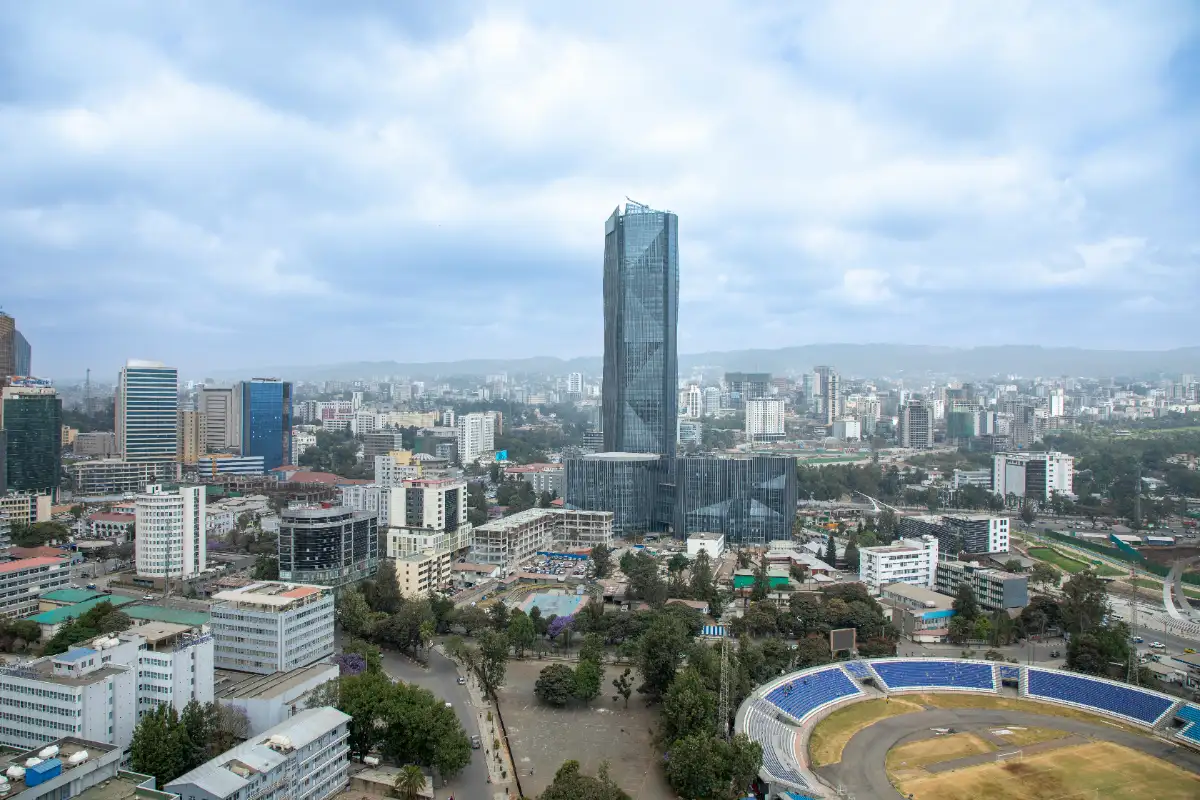
Addis Ababa begins at altitude. At two thousand three hundred and eighty five metres above sea level, it is the fourth highest capital city on earth, and the air makes its position known immediately when you step out of Bole International Airport into a morning that is cool and thin and somehow more present than the air of lower cities. The light here has a quality that painters and photographers have been trying to describe for decades. It arrives at an angle that turns the eucalyptus trees lining the city's broad avenues into something ancient and slightly ceremonial, as though the city arranged itself this morning specifically for your arrival.
Unique things to do in Addis Ababa are not hidden so much as they are underreported. The city receives a fraction of the international travel attention it deserves, partly because Ethiopia as a whole sits outside the mainstream Africa safari circuit and partly because Addis has been so thoroughly associated with diplomatic summits and humanitarian news that its identity as a city of extraordinary cultural depth, remarkable food, living ancient tradition, and genuine human warmth rarely makes it to the front of the travel conversation.
This guide is a corrective. It navigates the iconic sites that justify every superlative ever written about them, the hidden dimensions that most ordinary travellers miss entirely, the practical realities of moving through a city that rewards patience and curiosity in equal measure, and the platform that makes booking the best of it straightforward and reliable. Addis Ababa is not a stopover. It is a destination. This is how to treat it as one.
The Experiences in Addis Ababa That Are Extraordinary and Remain So Every Single Time
The National Museum of Ethiopia — Standing Three Feet From the Oldest Known Human Ancestor
The National Museum of Ethiopia on King George VI Street houses one of the most important palaeontological collections in the world and the single most significant human fossil discovery ever made. Lucy, known in Amharic as Dinkinesh, which translates as you are marvellous, is a three point two million year old Australopithecus afarensis skeleton discovered in the Afar region of Ethiopia in 1974 by palaeontologist Donald Johanson. She is housed in a purpose built case on the ground floor of the museum and she is forty percent complete, which in the context of fossil records from this period is extraordinary.
Standing in front of Lucy is not the same experience as reading about her. The scale of her skeleton, she would have stood approximately one metre ten centimetres tall, and the specificity of her preserved bone structure reorder the relationship between the abstract concept of human origin and the physical reality of it in a way that no documentary, no textbook, and no museum replica achieves. You are looking at your oldest confirmed ancestor and she is looking, in the particular way that three million year old bone looks, back.
The museum's upper floors house an extensive collection of Ethiopian historical artefacts, royal regalia, religious art, and archaeological finds from across the country's extraordinarily long recorded history. Ethiopia is one of the few African nations with a written historical record stretching back over three thousand years and the museum reflects that depth in a collection that most visitors do not have enough time for on a single visit.
Practical Details for Your National Museum Visit
The museum is open Tuesday through Sunday and is closed on Mondays. Entry fees are modest. Guided tours are available at the museum entrance and are strongly recommended for the palaeontology collection, where the contextual explanation provided by a knowledgeable guide dramatically expands what the display cases alone can communicate. Photography of Lucy herself is permitted in some configurations and restricted in others depending on current museum policy; confirm at the ticket desk before raising your camera.
The Ethiopian Coffee Ceremony — Not a Ritual for Tourists, a Ritual That Tourists Are Invited Into
Ethiopia is the birthplace of coffee. The wild coffee plant, Coffea arabica, originated in the forests of the Kaffa region in southwestern Ethiopia, and the Ethiopian relationship with coffee is not historical or nostalgic. It is daily, devotional, and conducted with a precision and intentionality that the global coffee industry has spent two decades trying to understand and has never quite replicated.
The traditional Ethiopian coffee ceremony, called bunna in Amharic, is a three round process that takes approximately forty five minutes to an hour to complete. Green coffee beans are washed and roasted over a charcoal burner in a flat pan until they are dark and aromatic. The roasted beans are ground in a wooden mortar and pestle and brewed in a clay pot called a jebena. The coffee is served in small handle free cups called cini, sweetened heavily or without sugar depending on the host's understanding of your preference, and accompanied by popcorn or sometimes roasted barley.
The ceremony is performed in homes across Ethiopia multiple times every day. It is a social institution as much as a beverage preparation and its function is as much about conversation, community, and the slowing of time as it is about caffeine. Experiencing it in an authentic domestic setting, invited by a local resident or arranged through a community guide, is categorically different from the performance versions available in tourist restaurants. The former is one of the most genuinely moving cultural experiences available in East Africa. The latter is coffee with a show attached.
Where to Experience an Authentic Coffee Ceremony in Addis Ababa
The most meaningful coffee ceremony experiences in Addis Ababa are arranged through community guides or local experience operators who have relationships with families willing to host visitors in their homes. The Tomoca Coffee roastery on Wavel Street, operating since 1953, is the most famous historic coffee house in the city and worth visiting for its atmosphere and its extraordinary espresso even if it is not a ceremony setting. Ask your Plan My Experiences operator specifically about home hosted ceremony arrangements for the most culturally immersive version of this experience.
The Addis Ababa That Most Ordinary Travellers Never Reach
Merkato — The Largest Open Air Market in Africa and a City Within the City
Merkato, in the Addis Ketema sub city west of the city centre, covers several square kilometres and is routinely described as the largest open air market in Africa, a description that does not adequately prepare you for the reality of being inside it. Merkato is not a market in the conventional tourist sense. It is an entire urban ecosystem that operates according to its own geography, its own social hierarchy, its own internal transport network, and its own economy that processes billions of Ethiopian birr in transactions every single week.
The market is organised into loosely defined sectors where particular categories of goods are concentrated: spices in one area, imported electronics in another, traditional textiles called shemma in another, coffee beans sold by the sack in another, livestock in another, recycled metal goods that have been beaten and shaped into everything from cooking pots to roofing panels in another. Walking through Merkato without a guide is an experience that produces genuine disorientation within minutes. Walking through it with someone who knows the internal logic of its layout, the names of the section leaders, and the history of which trading families have occupied which stalls for three generations is an entirely different and far more rewarding encounter.
The sounds of Merkato are as specific as its smells. The metalworkers section produces a layered percussion of hammers on different gauges of steel that from a distance sounds almost musical. The spice section smells of berbere and mitmita and fenugreek in a combination that is so distinctly Ethiopian that any subsequent encounter with those spices anywhere in the world will return you immediately to this market and this morning.
Safety and Etiquette in Merkato
Merkato is a busy working market and petty theft targeting distracted visitors does occur, particularly in the most crowded sections. Leave your expensive camera equipment at your accommodation and carry only what you are prepared to lose. Keep your phone in a front pocket rather than a bag. Go with a guide who is known in the market rather than hiring someone at the gate whose motivations and connections are unclear. The vast majority of people in Merkato are there to work and trade and have no interest in your possessions. A simple awareness of your surroundings and the guidance of a trusted local contact is all the protection a sensible ordinary traveller needs.
Holy Trinity Cathedral — Where Ethiopia's Modern History Kneels Down
The Holy Trinity Cathedral, known in Amharic as Kidist Selassie, is the most important Ethiopian Orthodox church in Addis Ababa and the resting place of Emperor Haile Selassie and his wife Empress Menen Asfaw. The cathedral was built between 1931 and 1944, damaged during the Italian occupation of Ethiopia from 1936 to 1941, and restored after liberation. Its architecture combines traditional Ethiopian ecclesiastical design with European Gothic elements in a synthesis that is entirely its own and belongs to no other building tradition anywhere.
The cathedral grounds also contain the tomb of Sylvia Pankhurst, the British feminist and anti fascist campaigner who spent the latter decades of her life in Ethiopia advocating for the country's independence and modernisation and who asked to be buried here among the people she had spent her life defending. Her presence in the cemetery alongside the royal family she supported reflects the kind of unexpected historical connection that makes Ethiopian history feel simultaneously local and globally entangled.
The interior of the cathedral is covered in murals depicting scenes from Ethiopian Orthodox Christian tradition and history in a visual language that is vivid, specific, and unlike anything in the Western religious art tradition. The golden light that filters through the stained glass in the afternoon turns the interior into something you want to sit inside for much longer than any itinerary typically allows.
The Piazza Neighbourhood — Old Addis in the City's Original Italian Skin
The Piazza neighbourhood in the Arada sub city is one of the oldest and most architecturally interesting areas in Addis Ababa. During the Italian occupation of Ethiopia from 1936 to 1941, the occupying forces built a significant number of buildings in the rationalist architectural style that characterised Italian fascist construction of the period: wide streets, low horizontal facades, large public squares, and building materials that were intended to communicate permanence and authority.
The occupation lasted only five years and left a complicated architectural legacy that Ethiopians have had entirely justified reasons to regard with ambivalence. What the Piazza area represents today, however, is a neighbourhood where that architectural skin has been absorbed into and transformed by the Ethiopian urban life that has inhabited it for the subsequent eighty years. The cafes on the Piazza square serve macchiatos that have been shaped by Italian coffee culture into something distinctly Ethiopian, with a specific preparation and a specific sweetness that you cannot find in exactly this form anywhere else on earth.
Walking the Piazza with a local guide who understands the neighbourhood's layered history, who can point to the building that served as the Italian command post and the one that became the first Ethiopian newspaper office and the one where a particular famous poet was born in an upstairs room, is one of the most intellectually satisfying walks available in Addis Ababa.
Entoto Hill — The Forest Above the City and the View That Explains Everything
Entoto Hill rises to approximately three thousand and forty metres above sea level at the northern edge of Addis Ababa and is covered in eucalyptus forest planted by Emperor Menelik II in the 1880s after he moved his capital to the Addis Ababa valley below. The forest is the reason Addis Ababa exists where it does: Menelik's wife Taitu is said to have discovered the hot springs at the base of the hill and persuaded the emperor to establish the permanent settlement there rather than continuing the nomadic tradition of moving the capital when local firewood resources were exhausted.
From the top of Entoto, on a clear morning before the city's midday haze builds, you can see the entire spread of Addis Ababa below you, its eight million inhabitants compressed into a basin between hills that gives the city its name: new flower in Amharic. The Menelik II Palace and the Entoto Maryam Church at the summit of the hill are both open to visitors and together represent the founding moment of the modern Ethiopian state in a location that feels appropriately elevated above the noise and movement of the city below.
Early morning visits to Entoto also offer one of the most affecting scenes in the city: long lines of women carrying enormous bundles of eucalyptus wood on their backs down the mountain paths, a daily labour that provides firewood for the city's households and income for women who have been performing this specific task on this specific hillside for generations.
Everything an Ordinary Traveller Needs to Know Before Visiting Addis Ababa
The Best Time to Visit Addis Ababa
Addis Ababa's climate is determined by its altitude rather than its latitude. The city sits close to the equator but at an elevation that keeps temperatures consistently moderate throughout the year, typically between fifteen and twenty five degrees Celsius during the day. The main rainy season runs from June through September, with the heaviest rainfall in July and August. The dry season from October through May is the most comfortable period for travel, with October and November particularly beautiful as the post rain vegetation is still lush and the skies are clear.
The Ethiopian calendar is a calendar system that differs from the Gregorian calendar by approximately seven to eight years, depending on the time of year, and runs thirteen months rather than twelve. This means that Ethiopian public holidays and festivals follow a different cycle from international expectations. The Ethiopian Christmas, Genna, falls on January seventh by the Gregorian calendar and is one of the most atmospheric and joyful public celebrations in Addis Ababa. Ethiopian New Year, Enkutatash, falls in September and is marked by flowers, singing, and a city wide celebration that transforms the streets.
Getting Around Addis Ababa
Addis Ababa has a functioning light rail transit system, the first in sub Saharan Africa, which opened in 2015 and connects the eastern and northern parts of the city in two intersecting lines. For ordinary travellers, the light rail is a useful and affordable option for specific journeys, particularly the north to south line that connects Merkato with Megenagna. Blue and white taxis are widely available and should be negotiated by fare before departure rather than metered. Ride share applications including Ride and Feres operate in Addis and provide a more predictable pricing experience for visitors uncomfortable with negotiation.
Altitude Acclimatisation for Visitors
The altitude of Addis Ababa causes mild altitude sickness symptoms in a significant proportion of visitors arriving from lower elevations. These symptoms typically include headache, mild breathlessness, disrupted sleep, and fatigue during the first twenty four to forty eight hours. The standard advice is to hydrate well, avoid alcohol on the first day, and not plan physically demanding activities for your first morning in the city. Most visitors find that symptoms resolve naturally within two days and that the altitude thereafter becomes simply a quality of the air rather than an imposition.
Book Your Addis Ababa Experience Through Plan My Experiences
Why Addis Ababa Rewards the Traveller Who Comes With the Right Guide
Addis Ababa is a city that has been dealing with the outside world for a very long time and has developed, over those centuries, a particular orientation toward visitors that is warm, curious, and generous without being deferential. The city does not arrange itself for tourism. It arranges itself for the ten million people who live in it every day, which means that the ordinary traveller who shows up expecting a curated experience will find the city slightly opaque and the ordinary traveller who shows up genuinely curious will find it endlessly giving.
The difference between those two outcomes is almost entirely a function of who is with you. A local guide in Addis Ababa is not a service provider in the transactional sense. They are an interpreter, a cultural translator, a person who knows which coffee shop on which corner in the Piazza makes the macchiato worth drinking and why that matters, who can take you to the Merkato stall run by the woman whose grandmother was in the same neighbourhood before the Italian occupation, and who knows the name of the priest at Holy Trinity Cathedral who gives the most articulate tour of the murals.
Plan My Experiences connects ordinary travellers with exactly these people. The platform is the premier African travel marketplace dedicated to surfacing the most knowledgeable, community embedded, and personally invested local guides and operators across Ethiopia and the wider region. Every experience listed on the platform has been assessed for quality, community benefit, and traveller satisfaction through a rigorous vetting process that generic booking platforms do not apply.
How to Find and Book Addis Ababa Experiences Through Plan My Experiences
Visit the Plan My Experiences website and search for Addis Ababa or Ethiopia. The platform surfaces curated experiences across the city's most compelling categories: National Museum guided visits with palaeontology specialists, home hosted coffee ceremony experiences with local families, Merkato walking tours with market insiders, Entoto Hill morning walks with historical context, Piazza neighbourhood walks, Ethiopian cuisine cooking classes, and full day city itineraries built around your specific interests and available time.
Every listing provides complete transparency: what the experience involves, who leads it, how long it takes, what previous travellers said about it, and exactly what it costs with no hidden fees. Communication with the local operator is direct and available through the platform before you book. You arrive in Addis Ababa knowing the name of your guide, what you are going to do together, and why that specific person is the right person to do it with.
For Local Guides and Experience Operators in Addis Ababa
If you lead cultural tours, coffee ceremony experiences, market walks, historical tours, cooking classes, art experiences, or any other visitor activity in Addis Ababa or anywhere in Ethiopia, Plan My Experiences gives you direct access to a global audience of ordinary travellers who are choosing Ethiopia specifically because they want depth of experience rather than surface level tourism.
Listing your experience on the platform is completely free. You set your own pricing and manage your own availability in your own words. Plan My Experiences charges a fair commission only when a confirmed booking is made. This model means the platform's success is built entirely on yours, that revenue stays in Ethiopia, in the communities and families that hold the country's extraordinary cultural knowledge, and with the guides who know how to share it responsibly.
Addis Ababa Asks Only That You Show Up Paying Attention
Unique things to do in Addis Ababa are not extreme or unusual. They are simply specific. They require the willingness to sit for forty five minutes drinking three rounds of coffee in someone's home when your instinct is to move on to the next item on the list. They require standing in front of a three million year old skeleton long enough for the implications of what you are seeing to actually arrive. They require walking into Merkato without a plan and trusting that the guide beside you knows where you are going even when you cannot see further than the next stall.
The ordinary traveller who gives Addis Ababa that quality of attention comes home carrying something that is hard to name but immediately recognisable to anyone who has experienced it: the particular weight of a city that has been at the centre of human history for three million years and has not finished being relevant yet.
Start your Addis Ababa journey at Plan My Experiences. Find your guide, book your experience, and arrive ready to be surprised by one of Africa's most extraordinary and most underestimated capitals.